18/07/2026 General News
One of our longest-standing – and most eagerly anticipated – auctions is our thrice-yearly East Anglian Art Sale, which showcases work by the many artists who called our part of the country home.
With its big skies, picturesque countryside and pure light, it is little surprise that East Anglia acts as a magnet for artists – and it has always held that allure. The result is a rich heritage of East Anglian art, a heritage which is increasingly recognised around the world – and which results in strong demand for works from our regional artists, both contemporary and long-gone.
East Anglia has produced some fantastic artists across the centuries, and its reputation as a hub for painters in particular has always led to others being attracted to live and work here.
Our region has produced some of the greatest artists across the years, from the leading lights of the Norwich School such as Crome and Cotman, to turn-of-the-century giants like Constable, Munnings and Seago.
We should be really proud that our region has gained a reputation worldwide for producing top-quality visual art, and this is reflected in the prices being achieved in the auction room, as well as the increasingly wide geographical spread of buyers for such work.
One artist whose work is always particularly sought-after is Eloise Harriet Stannard, who was one of the most successful and gifted still life painters of the Victorian era – a time when women faced massive institutional barriers in the arts (and in life more generally).
Stannard was one of only two notable women artists associated with the Norwich School of Painters, Britain’s first provincial art movement (the other being her aunt Emily Coppin Stannard).
Born in Norwich in 1829, she was one of 14 children of the landscape painter Alfred Stannard; her uncle was the artist Joseph Stannard.
A chronic heart condition restricted her ability to paint landscapes outdoors (as her father did), and so she naturally pivoted to studio-bound subjects, and still lifes in particular.
In her early career she was very much influenced by traditional Dutch still life painting, especially the artist Jan van Huysum, but by the 1860s she had abandoned rigid structural traditions in favour of her own signature style – a breathtaking naturalism enhanced by arranging her subjects in bright, natural sunlight, giving them a characteristic luminosity, enhanced by the use of several superimposed layers and very fine brushwork.
Most female Victorian artists painted strictly as a leisure activity, but Stannard ran a remarkably successful commercial practice. She began exhibiting her work at the British Institution in 1852 and secured a regular presence at the prestigious Royal Academy of Arts from 1856 until 1893. She died in 1915, the day after her 86th birthday.
Today Eloise is considered not just one of the greatest female painters, but one of the most gifted still life artists of all time. Her works sold well throughout her lifetime and remain extremely popular in the saleroom today – our East Anglian Art Sales often feature her work.
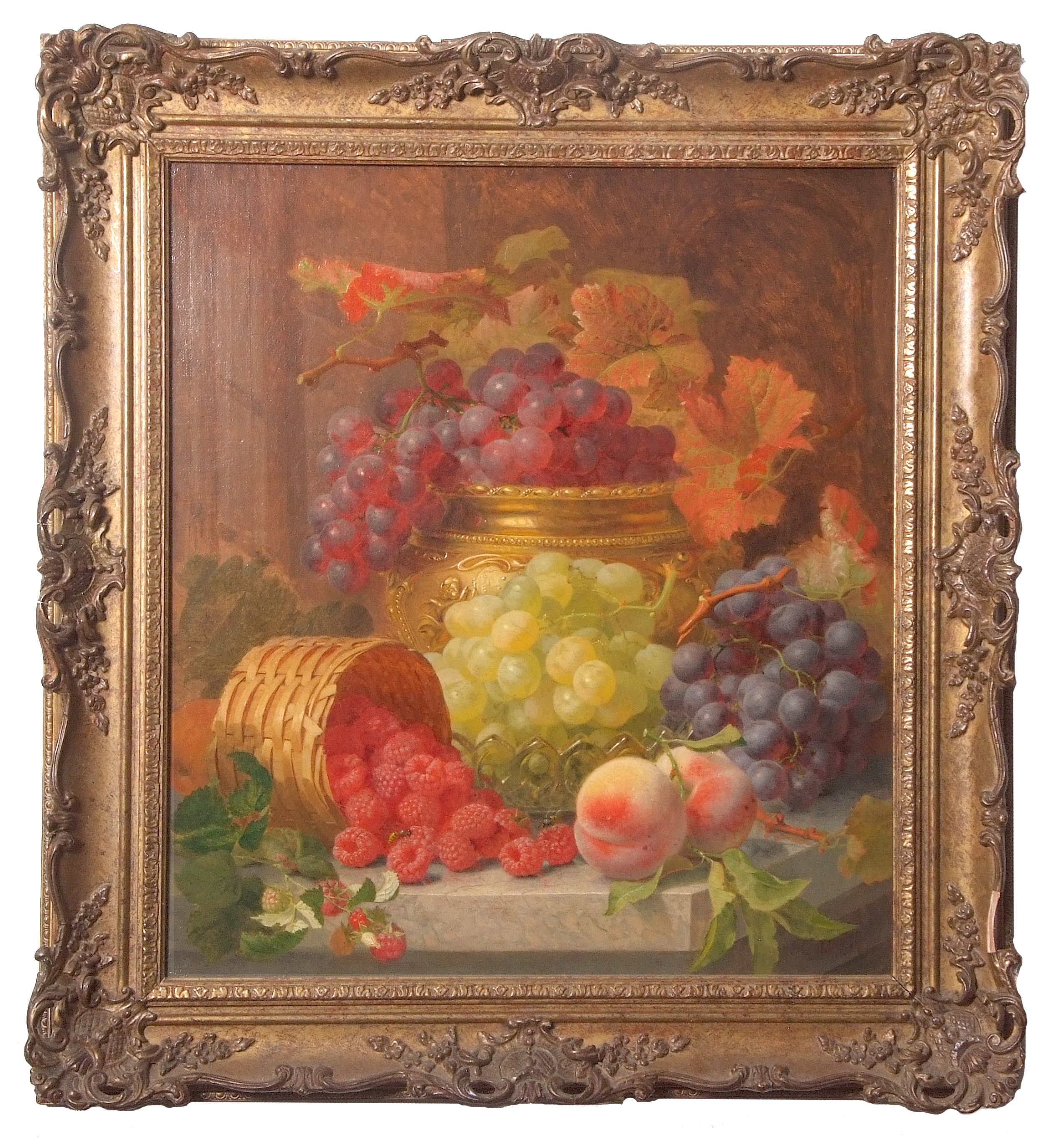
Our second such sale of 2026 features two stunning pictures by Eloise Harriet Stannard. The first is a still life study of fruit on a marble ledge or plinth, which was painted in 1887 when she was 48. It measures 49cm by 44cm and has a pre-sale estimate of £3,000-£4,000.
The second is a very late work painted in the year she died: a still life study of roses in a vase. Measuring just 29.5cm by 18.5cm, the pre-sale estimate for this one is £2,000-£3,000.