09/05/2026 General News
Wassily Kandinsky (1866-1944) was a Russian painter who is widely credited as one of the pioneers of abstract art, writes Daniel Smith. Although born in Moscow, he spent many of his artistically active years in Germany, although he was persecuted by the Nazis in the 1930s and eventually moved to France where he spent the last 11 years of his life, even becoming a French citizen.
Kandinsky didn’t really start painting seriously until he was 30, when he settled in Munich. Forced to return to Russia at the outbreak of the First World War, his artistic and political outlook were anathema to the 1917 revolutionaries, and he once again left Russia in 1920 for Germany. From 1922 he taught at the Bauhaus school of Art and Architecture until the National Socialists closed it down in 1933.
The inspiration for his abstract art came from many directions. There is a (possibly apocryphal) story that he came home to his studio one day to find one of his own paintings hanging upside down, and that he stared at it for some time before he realised it was indeed one of his own works, suggesting to him the power of abstraction.
That may be rather whimsical, but what is certain is that he took his influences from a wide variety of sources, including the Impressionists, who had emerged during his early life. One of the spurs for him to take up painting seriously was viewing Monet’s ‘Haystack’ series in 1896 at an exhibition. He was apparently awestruck, later declaring that the ‘worldly forms dissolved into a blaze of colour surpassed my wildest dreams’.
It wasn’t just art which inspired him; he said that Richard Wagner’s opera ‘Lohengrin’ ‘pushed the limits of music and melody beyond standard lyricism’, and approach he would bring to his art. He saw a strong affinity between music and art, believing in the phenomenon of synaesthesia, with sounds triggering visual cues, and vice-versa.
His earlier works were to a degree figurative, but as he entered his 40s the abstract increasingly took centre stage. Working alongside such Bauhaus luminaries as Paul Klee and László Moholy-Nagy at the Bauhaus school in the 1920s reinforced this direction, as well as introducing more geometrical components such as grids, triangles and circles.
None of this made him a friend of the Nazis, who regarded his work as ‘degenerate’. Fleeing to France helped him take a bold new direction, with a more playful, less geometric style. This was a period of great productivity: Kandinsky created 144 oil paintings and around 250 watercolours in the last decade of his life.
Kandinsky was an artist who embraced many artistic styles from his own lifetime, including Art Nouveau, Fauvism, Surrealism and Bauhaus. But he also very much ploughed his own artistic furrow, introducing synesthetic swirling hurricanes of colours and shapes and a biomorphic style.
In the saleroom, his main works can sell for huge sums; the record paid at auction was for a large 1935 abstract painting, ‘Rigide et Courbé’, which sold for $23.3 million. But his work can also offer a wide range of entry points for collectors, with prints, lithographs and attributed works much more accessible for those with more modest budgets.
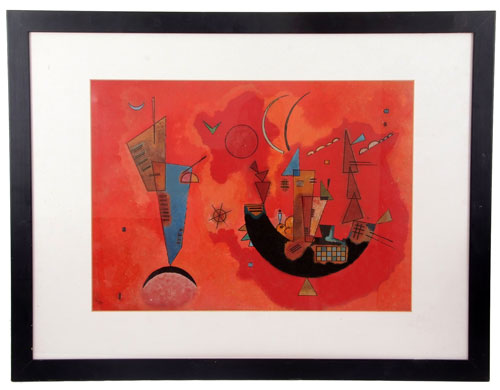
Keys’ Modern Art and Design Sale, which takes place later this month, has an abstract composition which is attributed to Kandinsky. Initialled and dated ’29 at the bottom left corner, it measures 58cm x 42cm. We have put a very cautious pre-sale estimate of £250-£350 on it; it may well make a lot more.