01/03/2026 General News
At the beginning of the 18th century, Augustus the Strong, Elector of Saxony, summoned one Frederich Böttger to his court, writes David Broom. Böttger was a young alchemist, alchemy being the fabled ability to turn base metal into gold.
But Augustus wasn’t looking to replenish his bullion coffers. Instead, he believed that Böttger could give him something even more precious – a substance which many European rulers had already spent a good part of their precious metal reserves chasing: porcelain.
In the 1600s, no European had cracked the secret of turning clay into porcelain, and as a result the Chinese, who had the monopoly on manufacturing it, were becoming very rich indeed - at Europe’s expense.
The French ‘Sun King’ Louis XIV had melted down all of the silverware in Versailles in order to finance the purchase of it – Asian producers and traders accepted only gold and silver in payment.
Why was it so in demand? With its pure white colour, its sumptuous decoration and its unique malleability, it exceeded any other ceramic of the era. The European aristocracy went crazy for it, and as a result, the race to discover the secret of making fine porcelain in Europe became a serious and well-funded one.
In 1707 Böttger made a huge breakthrough, successfully replicating red stoneware, or jaspis porcelain using red clay. This meant the basic secret of porcelain had been unveiled, and the following year, on 15th January 1708, the first European white porcelain was made, using white kaolin.
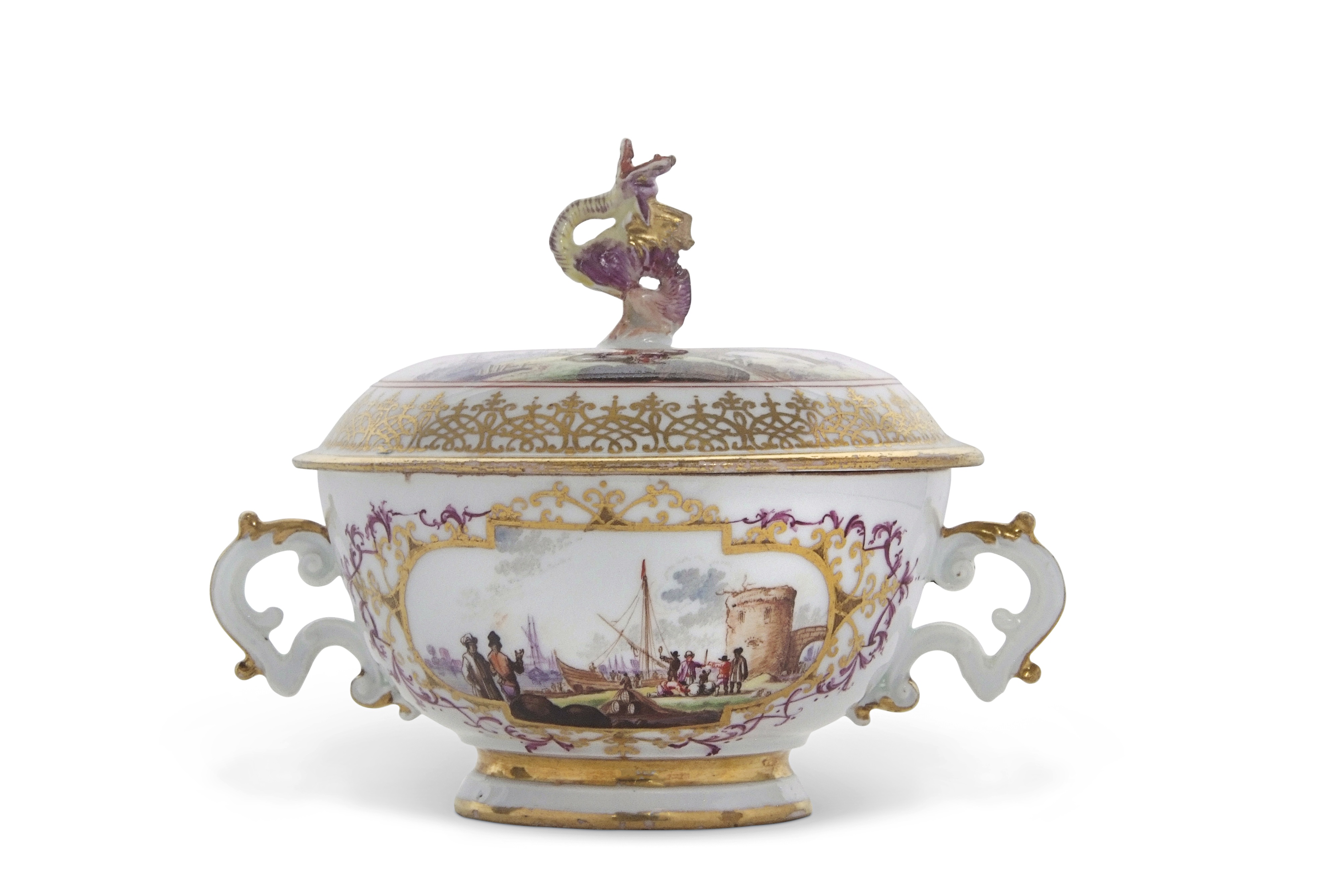
Sensing the huge value of what had been achieved with his funds, Augustus created a new porcelain factory in Meissen near Dresden, named ‘The Royal Polish and Electoral Saxon Porcelain Manufactory’. Much emulated, this was the first and greatest European porcelain maker, and to mark that fact – and distinguish Meissen from other makers – in 1722 the crossed swords device was adopted, one of the oldest continuously-used trademarks in the world.
Perhaps inevitably, much of the early Meissen ranges featured chinoiserie motifs, but it didn’t take long for Meissen to develop its own unique style. The factory’s chief modeller Johann Joachim Kändler created a definite house style, with animal sculptures, allegorical figures and characters from literature (especially the Commedia Dell’ Arte) all featuring. These are among the most sought-after pieces in the saleroom today.
Innovations continued into the 19th century, including ‘liquid bright gold’, a liquid gold preparation which did not require polishing after firing, unlike burnished gold. This allowed detailed reliefs to be completely gilded for the first time.
More than 300 years after Böttger made his breakthrough, Meissen remains one of the world’s foremost porcelain manufacturers, once again under the ownership of the state of Saxony
The marque’s high quality workmanship is the reason that Meissen porcelain remains one of the most sought-after names in ceramics in the saleroom. Early 18th century pieces can make thousands, with sculptural pieces always in demand. When Frederich Böttger succeeded in turning humble clay into beautiful porcelain, his status as an alchemist was finally confirmed.